
FTM Top Surgery: Understanding Your Surgical Options
One of the most common questions we receive from patients exploring top surgery is: “Which FTM Surgical Technique is right for me?”.
It is an excellent question, and the honest answer is that there is no universal approach. The right technique depends on your body, your goals, and your chest size.
At the Nuffield Hospital Clinic in Plymouth, Mr Fitton sees patients from across Devon and Cornwall — and further afield — who are at different stages of their journey. Some are certain they want surgery and simply want to understand the options in detail. Others are still weighing up whether surgery is the right path for them. Whichever stage you are at, we hope this guide helps you feel more informed.
The principles of Female to Male Chest Reconstruction are to remove the breast tissue, obliterate the breast fold, site the nipple in the correct anatomical position and to re-drape the skin.
There are currently three principal surgical techniques used in FTM chest reconstruction.
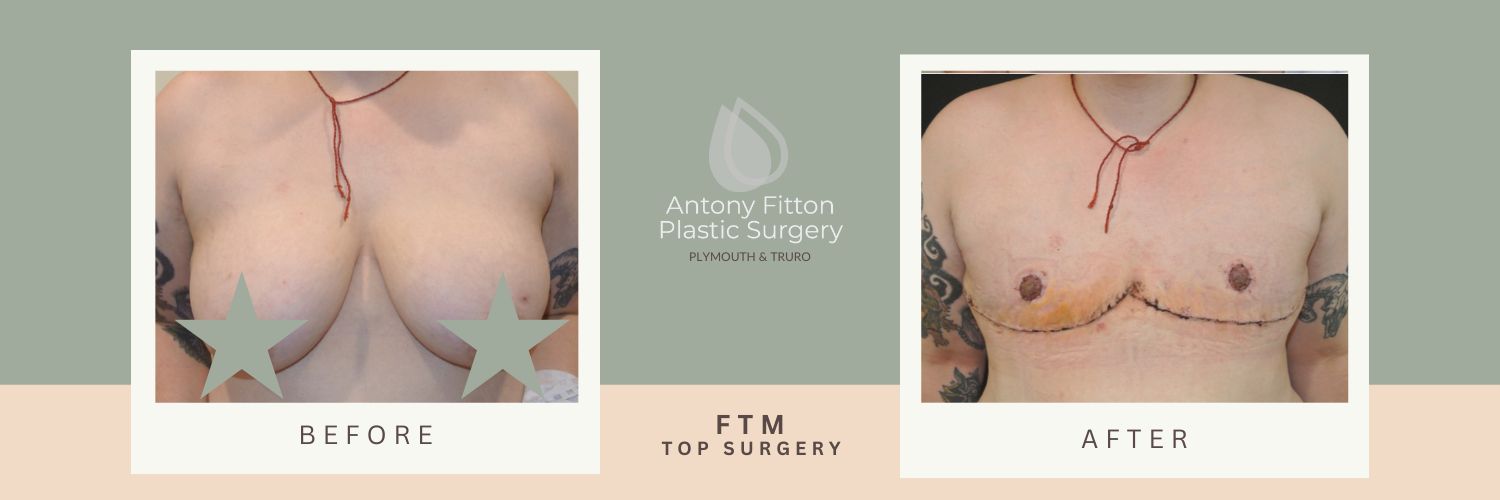
- Double Incision with Free Nipple Grafting — the most common method, suited to larger chest sizes, with horizontal chest scars and grafted nipples
- Periareolar Mastectomy — for smaller volumes, with the scar hidden around the areola and better nipple sensation preserved
- Keyhole / Subcutaneous Mastectomy — for very small, elastic chests in younger patients, relying on skin contraction for a minimal-scar result
Each has its own indications, advantages, trade-offs, and suitability criteria. In this article we include an honest discussion of the surgical techniques used, risks and complications, plus what to expect on the day and during recovery.
1. Double Incision with Free Nipple Grafting
What is it?
The double incision technique is the most commonly performed method for FTM top surgery, and for good reason: it is versatile, produces reliable results, and is appropriate for a wide range of chest sizes, including those with larger breast volumes.
The procedure involves making two curved or linear incisions across the lower chest — one beneath each breast — through which the breast tissue is fully removed. The skin is then re-draped over the chest wall and the excess removed. The result is a flat, masculine chest contour with a horizontal scar sitting along the natural lower chest crease.
What happens to the nipples?
Because significant skin is removed, the nipples cannot remain attached to their blood supply in the usual way. Instead, they are removed, resized, and repositioned as free nipple grafts — placed in anatomically appropriate positions to give a natural, masculine appearance.
Who is it suited to?
• Those with larger breast volumes (typically B cup or above, though each patient is assessed individually)
• Patients with less skin elasticity, where natural contraction of remaining skin would not be adequate
• Anyone where a flatter, well-defined chest result is the priority
Trade-offs to be aware of
Because the nipples are grafted rather than kept on a pedicle, there is a small risk of partial or complete nipple graft failure. If this occurs, the wound heals naturally and nipple tattooing is a very effective option afterwards.
Sensation in the nipples is also affected — most patients experience reduced or altered sensation, which may partially return over time.
Scarring is more visible than with other techniques, though it typically fades to a thin line. Patients with a tendency toward keloid scarring should discuss this with Mr Fitton during consultation.
2. Periareolar Mastectomy
What is it?
The periareolar technique (sometimes called circumareolar) involves making an incision around the edge of the areola, through which breast tissue is removed. The nipple and areola remain attached and alive throughout — which is a significant advantage in terms of preserving sensation and reducing visible scarring.
Because the incision follows the natural border of the areola, the resulting scar is confined to this circular edge. With good healing, it can become very discreet over time.
Who is it suited to?
• Patients with smaller breast volumes — typically an A or small B cup
• Those with good skin quality and elasticity, as the skin needs to contract down smoothly
• Patients where preserving nipple sensation is a particularly important consideration
Trade-offs to be aware of
The periareolar technique is not appropriate for larger breast volumes. Attempting it in those cases leads to puckering of the surrounding skin, uneven contours, and unsatisfactory results. Selecting patients carefully for this technique is essential.
Some patients also require a small reduction in the size of the areola as part of the procedure, to ensure a proportionate result.
3. Keyhole / Subcutaneous Mastectomy (Double Incision Beneath the Nipple)
What is it?
This technique — sometimes referred to informally as “keyhole” — involves making small incisions in the tissue directly beneath the nipple, through which breast tissue is removed. There is no incision around the areola and no incision across the lower chest.
The approach relies on the remaining skin contracting after the breast tissue is removed. When this works well, the result is a flat chest with minimal visible scarring — which many patients find extremely appealing.
Who is it suited to?
• Younger patients whose skin is highly elastic and likely to contract well
• Those with a small chest — typically an A cup or smaller
• Patients who prioritise minimal scarring above other considerations
Trade-offs to be aware of
The success of this technique is highly dependent on skin contraction. If the skin does not contract sufficiently, the result can appear loose or uneven — and revision surgery may be required. For this reason, Mr Fitton uses his vast experience to exercise careful judgement about which patients are likely to be good candidates.
It is also worth noting that this technique offers less ability to precisely reposition the nipples compared to the free nipple graft approach, so the starting position and size of the nipple-areolar complex matters.

Am I Ready For Plastic Surgery?
Download your free self-assessment checklist to help you reflect on whether now is the right time for you — emotionally, physically, and practically.
At a Glance: Comparing the Three Techniques
- Double Incision: Best for larger chest sizes. Most common technique. Horizontal scar across lower chest. Nipples removed and regrafted. Some risk to nipple sensation and viability.
- Periareolar: Best for smaller chest sizes with good skin elasticity. Scar hidden around the areola. Nipple remains attached and sensation better preserved.
- Keyhole: Best for very small, elastic chests in younger patients. Minimal visible scarring. Relies on skin contraction — not suitable for everyone.
- Double Incision: Best for larger chest sizes. Most common technique. Horizontal scar across lower chest. Nipples removed and regrafted. Some risk to nipple sensation and viability.
What to Expect From the FTM Procedure
Whichever technique is chosen, all three approaches share a number of common features:
• Surgery is performed under general anaesthetic
• A minimum of one overnight stay is required
• Drains are inserted to reduce the risk of blood collecting at the operative site — these are typically removed the following morning
• Wounds are closed with soluble sutures and reinforced with steri-strips
• The procedure typically takes between 90 and 120 minutes
After surgery, you can expect a degree of bruising and swelling, which resolves gradually over the following weeks. Mr Fitton recommends wearing a snug surgical binder for at least a fortnight after your operation — this supports the healing tissue and helps reduce swelling.
Bilateral mastectomy is a significant undertaking, both physically and psychologically, and some fatigue is entirely normal for up to six weeks. Mr Fitton advises patients to avoid swimming and intensive gym exercise during this period, though gentle movement and shoulder physiotherapy are actively encouraged.
Understanding the Risks
As with any surgery, there are risks Mr Fitton wants every patient to understand clearly before proceeding. These include:
• Poor scarring — though most scars settle to a fine white line, they can occasionally remain raised or reddened, and rarely keloid scarring occurs
• Infection — antibiotics are given at the start of the procedure to reduce this risk
• Bleeding and haematoma — the breast is a naturally vascular structure, and occasionally a drain is needed for longer than anticipated
• Asymmetry — minor differences between left and right are normal and to be expected
• Free nipple graft failure — if a graft fails, the wound heals naturally and tattooing is possible
• Seroma — a collection of fluid at the operative site that may require drainage
• Dog ears — small puckers at the ends of scars, particularly with larger chests, which can be revised if they do not settle
Mr Fitton gives transparent, open conversations about all of these possibilities. His aim is never to alarm patients, but to ensure you are fully informed and feel confident in your decision.
Making the Decision: Your Consultation With Mr Fitton
The most important factor in choosing the right technique is a thorough one-to-one consultation. During that appointment, Mr Fitton will assess your chest size, skin quality, nipple position, and overall health — and will take the time to understand what matters most to you. Your goals and preferences are central to the plan you develop together.
Mr Fitton works with transgender and non-binary patients of all backgrounds, and understands that arriving at this point in your journey involves significant thought and courage. Mr Fitton and his team aim to ensure you feel heard, respected, and well supported throughout every stage of the FTM surgery process.
Our observations and conversations indicate the overwhelming majority of our patients gain enormously from their surgery and move forward in their lives, often better than they had hoped.
Patients sometimes ask whether they need a referral or formal diagnosis to proceed privately. The answer is that if you are pursuing top surgery privately, the process is more straightforward than the NHS pathway. Mr Fitton is happy to discuss this with you directly during your consultation.

Remember: Plastic surgery can be a life-changing decision, offering both cosmetic and functional benefits.
However, it is crucial to have accurate information and realistic expectations. Consulting with a certified and experienced plastic surgeon is the best course of action to ensure you receive personalised advice and clear answers to any queries.
– Educate Yourself: Research procedures thoroughly.
– Prepare for Recovery: Understand the time and effort needed for healing.
– Prioritise Your Safety: Choose reputable clinics and experienced professionals.
Ultimately, informed decision-making plays a vital role in achieving satisfactory results in any cosmetic procedure.
Take the First Step and Arrange a Confidential Consultation
For a no-obligation quote, tailored specifically to you, please book in for your consultation with Mr Fitton. Your requirements will be discussed in full confidence in a friendly and relaxed atmosphere.
- Email: info@antonyfitton.co.uk
- Phone: 07494 250277
- Website: plasticsurgeryplymouth.com
Following your consultation, the price you are quoted includes everything and there are no extra or hidden costs. Advice, treatment and aftercare are all part of our package to ensure your experience is positive from beginning to end.
About your Plastic Surgeon: Mr Antony Fitton
MB, BS(hons)., MD., FRCS(eng)., FRCS(plast).
Mr Antony Fitton qualified at the Royal London Hospital in 1989 with distinction in Surgery. He holds an MB, BS(Hons)., MD., FRCS(eng). and FRCS(plast). (Fellowship at the Royal College of Surgeons).
He is a member of BAPRAS (British Association for Plastic, Reconstructive and Aesthetic Surgeons), BAAPS (British Association for Aesthetic Plastic Surgeons), and BSSH (British Society for Surgery of the Hand).
Mr Fitton has received the Paton & Masser Award and the CM Matthews Award from the Royal College of Surgeons of England for his research in nerve injury.
Mr Fitton is licensed as a Plastic and Reconstructive Surgeon by the GMC.

- 0% Finance Available
- Consultations and treatments are available at the Nuffield Health Hospital, Plymouth
- Care Quality Commission Regulated
- GMC Specialist Registered Surgeon
- BAPRAS, BAAPS and BSSH member
- Registered MD
Life-changing result
"I just wanted to thank you (and your team) for the life-changing result of my top surgery. This will provide me with the freedom that I’m excited to enjoy, including being able to go swimming and actually staying cool in summer! All jokes aside, you have helped to mark a new chapter in my life, for which I am incredibly grateful… ALL the best."
Our appearance has an impact on how others perceive us. We are experts in creating an improved version of you. You can click on the procedure below for more information.
Body surgery (or contouring) can involve all or one of the following, with a prime focus on areas such as the buttocks, tummy, thighs, arms, and breasts. Click on the links below for more information.
There are several different types of hand surgery but all aim to restore functionality while making the hand look as normal as possible. Click on the links below for more information.
FTM Top Surgery: Risks, Complications, and What to Expect Afterwards
Every patient who comes to see Mr Fitton about FTM top surgery asks the same question at some point:
Accessing Gender-Affirming Care in the UK | Private FTM Top Surgery
Explore why many FTM and non-binary patients are choosing private top surgery in the UK to avoid lon
FTM Top Surgery: Understanding Your Surgical Options
There are currently three principal surgical techniques used in FTM chest reconstruction. Each has i